A recent McKinsey article1 argues that AI agents are not merely accelerating software development—they are fundamentally changing how software is built.
The shift is from sprint-based delivery to a near-continuous model where humans direct strategy and AI agents execute structured work.
From sprints to continuous execution
The key shift is from traditional sprint-based delivery to a near-continuous development model. Human teams define priorities, review outputs, and provide architectural guidance during the day, while AI agents execute structured work overnight: refining requirements, generating code, running tests, and validating implementations.
According to McKinsey, organizations that redesign their operating model around human–AI collaboration are already reporting significant productivity gains, including three- to fivefold improvements and substantially smaller delivery teams.
What enables adoption
However, the technology itself is only part of the story. Successful adoption depends on standardized workflows, reusable architectures, machine-readable specifications, and strong organizational knowledge systems. McKinsey highlights knowledge graphs as a critical component.
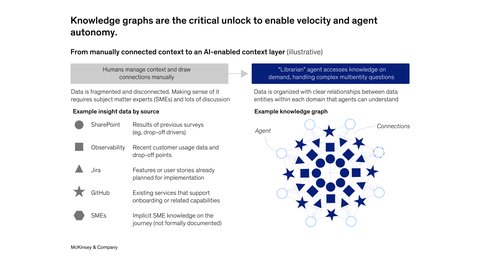
This is what enables AI agents to access institutional context, decisions, documentation, and business rules.
How roles will evolve
The implication is clear: the future role of software professionals will shift from producing artifacts to supervising systems, making architectural judgment, domain expertise, and governance increasingly important.
The question for teams
For organizations building digital products, the question is no longer whether AI will assist software delivery, but how quickly teams can adapt their processes to work effectively alongside autonomous agents.
McKinsey & Company, Rewiring software delivery for the agentic era, accessed June 9, 2026. ↩︎